Perth homes love big glass. Sliding doors that open onto the patio, wide living room windows that catch the afternoon light, bay windows that wrap around a dining table. They make a house feel open and bright, and in our climate that is half the joy of living here. But when it comes time to cover them, most window treatments start to struggle. A roller blind gets heavy and hard to lift at that width. Curtains need a lot of fabric and a lot of wall space to stack back. Shutters can cost a small fortune across a four metre opening.
Vertical blinds were built for this exact problem. Long vanes hang from a top track, rotate to control light, and slide to one side like a curtain when you want the whole opening clear. They suit Perth because they handle width gracefully, they cope with the daily use a sliding door gets, and they give you fine control over glare without shutting out the breeze or the view. This guide covers how they work, which vane material suits which room, how they compare with panel glides and curtains, and what to measure so your set fits first time.
In This Guide
- Why Vertical Blinds Suit Perth Homes So Well
- How Vertical Blinds Actually Work
- Fabric, PVC and Aluminium Vanes Compared
- Wide Windows, Sliding Doors and Bay Windows
- Light, Privacy and Heat: Getting the Balance Right
- Measuring and Fitting: What to Get Right
- Vertical Blinds vs Panel Glides and Curtains
- Frequently Asked Questions
1. Why Vertical Blinds Suit Perth Homes So Well
Walk through any Perth suburb, from Joondalup to Willetton to Mandurah, and you will see the same pattern: homes built around wide openings. Sliding doors lead to alfresco areas, living rooms stretch across the back of the house, and bedrooms often have a wide window facing the garden. Vertical blinds match that architecture because they are one of the few treatments that scale up in width without becoming awkward to use.
They also suit the way we live with the weather. On a hot summer afternoon the Fremantle Doctor pushes in from the coast and a lot of Perth households throw the sliding door open to catch it. Vertical blinds can stay in place with the door open, the vanes turned to shade the room while air moves freely around them. Come winter, when a storm front rolls in off the Indian Ocean, the same blinds close right up to keep the cold draught and the glare off the glass.
There is a practical point too. A sliding door is used dozens of times a day in a busy household. A treatment that has to be lifted or folded away every time gets in the way. Vertical blinds stack to one side and leave the doorway clear, so the door works exactly as it should.
- Cover widths of three metres and beyond without the weight problems of a single wide roller
- Stack neatly to one side so sliding doors stay fully usable
- Rotate to cut glare while still letting the afternoon sea breeze through
- Work well in rentals and family homes because individual vanes can be replaced if one is damaged
2. How Vertical Blinds Actually Work
A vertical blind is simpler than it looks. Individual vanes, usually 89 mm or 127 mm wide, hang from small carriers that run along a slim headrail fixed above the window or door. A wand or a chain rotates all the vanes together, and a cord or wand draws them along the track to stack at one end, in the middle, or split to both sides.
That rotation is the clever part. Turn the vanes flat and the blind is effectively closed, giving you privacy and shade. Turn them edge on and light pours in while the vanes themselves almost disappear against the window frame. Set them at an angle and you get the best of both: daylight in the room, direct sun kept off the floor and furniture, and a clear view of the garden past the edges of the vanes.
Most Perth households choose the wider 127 mm vane because it looks more modern and needs fewer vanes across a big opening, which means fewer gaps and a cleaner line. Ask for a wand control rather than a looped chain if you have small children or pets. A wand is simpler, safer, and one less thing to snag when the door is in constant use.
3. Fabric, PVC and Aluminium Vanes Compared
Fabric vanes are the most popular in Perth living areas and bedrooms. They come in a huge range of colours and textures, from sheer weaves that soften the light to blockout fabrics that shut it down almost completely. A blockout fabric vane is a genuine option for a bedroom that faces west and cops the full afternoon sun. Fabric vanes are light and quiet, and they look soft against painted walls and timber floors. They do need a bit more care: a vacuum with a brush head once a month and a spot clean for marks.
PVC vanes are the workhorse choice for wet areas and hard use. They wipe clean with a damp cloth, they do not absorb moisture, and they hold up well in bathrooms, laundries and kitchens. They are also a sensible pick for a sliding door that leads to the pool. PVC vanes are stiffer than fabric, so they hang very straight and give a crisp, tidy line across a wide opening.
Aluminium vanes are the least common in Perth homes today, but they still have a place. They are tough, they reflect heat well, and they suit a modern or commercial look. They can be noisier in a breeze and they show dents more than the other materials, so we usually steer homeowners toward fabric or PVC for living spaces and keep aluminium for offices, studios and workrooms.
- Fabric vanes: softest look, best colour range, blockout options for west facing bedrooms
- PVC vanes: wipe clean, moisture proof, best for bathrooms, laundries and pool side doors
- Aluminium vanes: tough and heat reflective, better suited to offices and workrooms than living areas
4. Wide Windows, Sliding Doors and Bay Windows
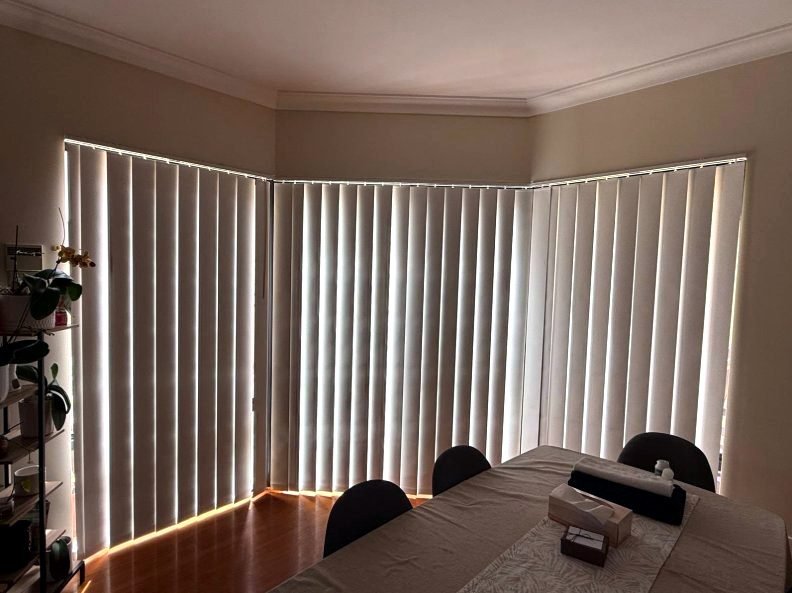
This is where vertical blinds earn their keep. A bay window is a good example. The photo at the top of this guide shows one of our recent installs: white vertical blinds running right around a bay window in a Perth dining room. Because each vane hangs on its own carrier, the track can be bent to follow the angles of the bay, and the blinds sit neatly across all three faces of the window.
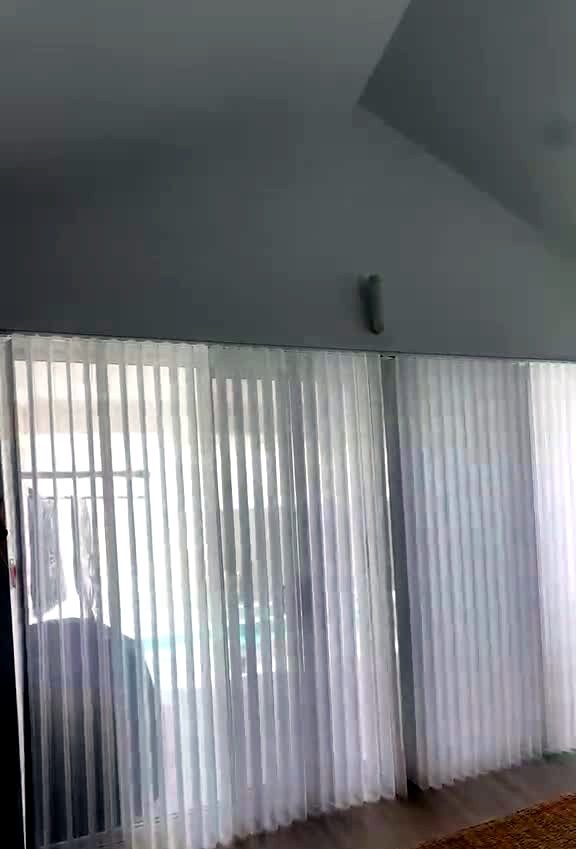
Sliding doors are the other classic case. A vertical blind on a sliding door stacks to the side the door does not slide toward, so the opening stays clear and the blind never blocks the handle. When the blind is closed, the vanes cover the full height of the door, which stops the low evening sun from blasting straight into the living room.
For very wide openings, four metres and beyond, talk to your supplier about track strength and carrier quality before you order. A cheap track will sag or drag under the weight of that many vanes, and a blind that is hard to draw soon stops being used at all. A good quality aluminium headrail with smooth running carriers makes the difference between a blind you love and a blind you fight with every evening.
5. Light, Privacy and Heat: Getting the Balance Right
Perth sun is not gentle. A west facing living room can go from pleasant to unbearable between three and six in the afternoon in January, and the right blinds can be the difference between a room you use and a room you avoid. Vertical blinds give you more settings than a simple open or shut treatment, and that matters.
For heat, the trick is to close the vanes flat against the afternoon sun before the room heats up, not after. Glass lets the heat in and then traps it, so a blind drawn at midday does far more than one drawn at four oclock when the room is already hot. Blockout fabric vanes do the best job here, and a light colour on the sun facing side reflects more heat back out through the glass.
For privacy, vertical blinds are excellent on ground floor rooms that face the street or a neighbour. With the vanes angled you can see out while no one can see in clearly, which is a big plus in suburbs where houses sit close together. At night, close them flat and the room is private.
One honest limit to know: vertical blinds are not the best choice if you need total darkness for shift work sleep. The small gaps between vanes can let in thin lines of light. If blackout conditions matter, look at a blockout roller blind with side channels for the bedroom, and keep vertical blinds for the living areas where their light control shines.
6. Measuring and Fitting: What to Get Right
Vertical blinds are forgiving to measure, but there are a few traps that catch people out. The first is the stack. When the blinds are drawn open, all the vanes gather at one end, and that stack takes up space, typically around 15 to 20 percent of the total width. If you stack them over the glass, they will block light and part of your view even when open. Plan the stack to sit over the wall beside the window or door where you can, and allow extra track length for it.
The second trap is the drop. Measure in three places across the width and use the longest drop, because floors and ceilings are rarely perfectly level in a Perth home, especially in older houses in suburbs like Fremantle or Subiaco. If the blind is fitted inside the reveal, allow a small clearance at the bottom so the vanes do not drag on the sill or the floor.
The third is the door handle. On a sliding door, check how far the handle sticks out from the frame. Vanes hanging too close will catch on the handle every time the door slides. A face fit with the track mounted far enough out from the wall solves this, and it also lets the blind clear any architrave. This is one of those details a professional measure picks up in minutes. If you would like us to measure for you, get in touch and we will book a time that suits.
- Measure the drop in three places and use the longest measurement
- Allow for the stack: vanes gathered open take up 15 to 20 percent of the width
- Check sliding door handle clearance before choosing inside or face fit
- A professional measure is free and catches the traps a tape measure misses
7. Vertical Blinds vs Panel Glides and Curtains
Vertical blinds are not the only answer for a wide opening, so it is worth knowing how they stack up against the other two common choices. Panel glide blinds are the modern alternative: wide flat panels that slide across the opening on a track. They look sleeker and more contemporary, and they are a great pick for a clean, minimal look in a new build. They cost more than vertical blinds, and they give you less fine control over light, because a panel is either open or shut with nothing in between.
Curtains, especially sheer curtains layered over a blockout backing, give the softest and most luxurious finish of all. They are the best choice when the window is a feature of the room and you want it to look dressed rather than just covered. But curtains need wall space to stack back into, they need regular washing, and they can be a lot of fabric and cost across a four metre opening.
So the honest summary is this. Choose vertical blinds when you want practical, affordable, everyday control over a wide window or a sliding door, and you are happy with a neat, functional look. Choose panel glides when the look matters most and the budget stretches. Choose curtains when you want softness and luxury and the room can spare the stack space. And if you are torn, come and talk to us. We fit all three, so we will tell you which one suits your room.
Frequently Asked Questions
Q. Are vertical blinds good for sliding doors?
Yes, they are one of the best options for sliding doors. They stack to one side so the doorway stays clear, they cover the full height of the door, and you can rotate the vanes to control glare without blocking the breeze. Just make sure the stack sits on the side the door does not slide toward, and check the handle clearance before you order.
Q. Do vertical blinds block out heat in summer?
They help a lot, especially in blockout fabric. Close the vanes flat before the afternoon sun hits the glass and they cut a large share of the heat and glare coming into the room. Light coloured vanes reflect more heat. They will not insulate as well as a honeycomb blind or a lined curtain, but for a wide opening they are a strong and practical choice.
Q. Can vertical blinds be motorised?
Yes. Motorised vertical blinds are available, and they are worth considering for very wide openings or hard to reach windows where drawing a heavy set of vanes by hand gets tiring. A motorised track lets you open, close and rotate the vanes at the touch of a button or on a timer.
Q. How do you clean vertical blinds?
Vacuum fabric vanes with a brush attachment once a month and spot clean marks with a damp cloth and mild detergent. PVC vanes just need a wipe with a damp cloth. Individual vanes can be removed and replaced, so a stained or damaged vane does not mean replacing the whole blind.
Q. How long do vertical blinds last?
A good quality set typically lasts 8 to 12 years in a Perth home, depending on the material and how much sun it gets. Fabric vanes on a west facing window will fade sooner than PVC vanes in a shaded room. Replacing worn vanes and keeping the track clean are the two things that stretch the life of a set well beyond that range.