Panel glide blinds in Perth solve a problem that shows up in almost every modern home here. The sliding doors are wider than they used to be, the living room glass runs further than a single roller blind can cover neatly, and one treatment has to look good from the kitchen, the dining table and the couch at the same time. A standard blind on a four metre opening either looks stretched, hangs unevenly, or needs a join that spoils the clean line. Panel glides were made for exactly this kind of opening.
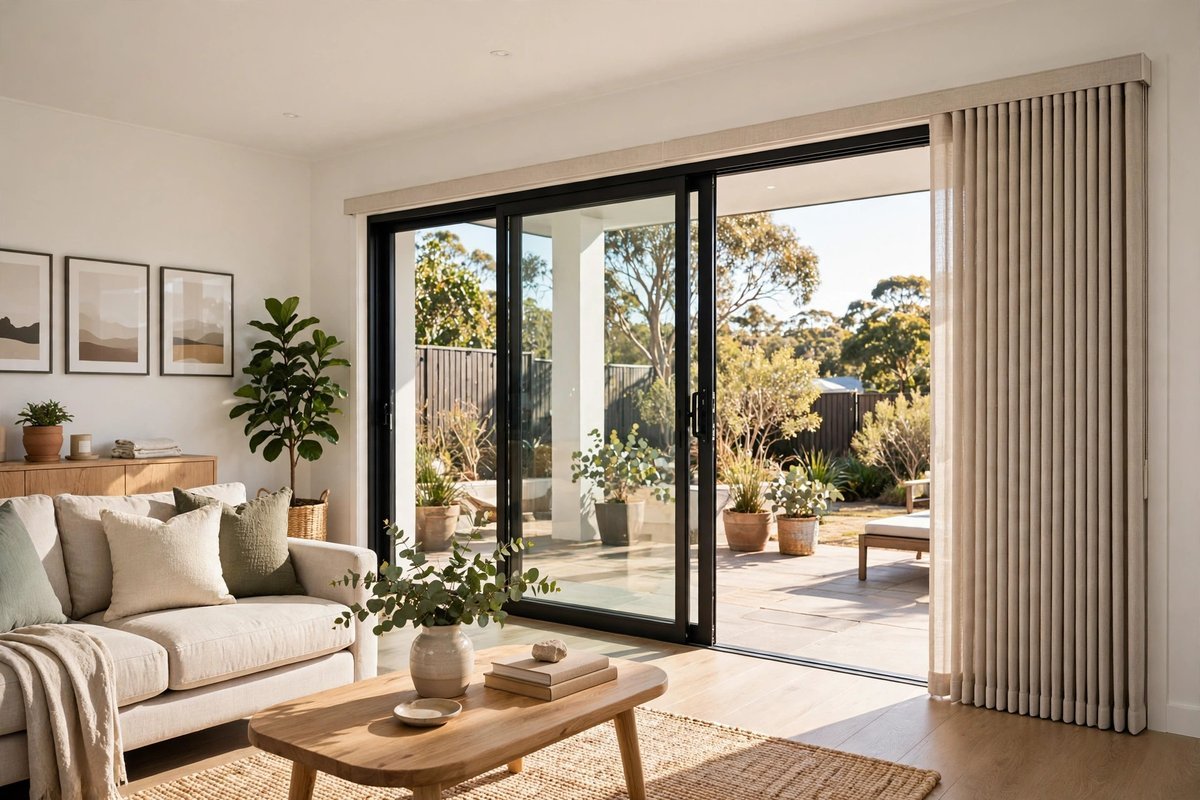
If you have not seen them before, picture this. Instead of one wide sheet of fabric, or a row of narrow vertical slats, a panel glide is a set of tall, flat fabric panels that slide sideways along a slim track. You pull a wand or a cord and the panels glide across the glass like a soft sliding wall, then stack neatly to one side when you want the opening clear. They look calm and architectural, which suits new homes in Baldivis and Ellenbrook just as well as renovated character homes in Mount Lawley and Fremantle.
Perth conditions shape the choice more than most people expect. Our hot dry summers punish a west facing wall of glass, the afternoon Fremantle Doctor sea breeze is the best free cooling we have and should not be blocked by a heavy treatment, and winter storm fronts bring driving rain and salt air to coastal suburbs from Cottesloe to Scarborough and down to Rockingham. This guide covers how panel glides handle all of that, which fabrics suit each room, how they compare with the alternatives, and the measuring details that matter.
In This Guide
- What Panel Glide Blinds Actually Are
- Why They Suit Perth Wide Openings So Well
- Fabrics: Blockout, Light Filtering and Sunscreen
- Panel Glide vs Vertical Blinds vs Sheer Curtains
- Measuring and Fitting: Tracks, Stacking and Clearance
- Living With Them: Cleaning, Salt Air and Daily Use
- Cost, Lead Time and Getting a Quote
- Frequently Asked Questions
1. What Panel Glide Blinds Actually Are
A panel glide blind is a track system fitted above or inside a wide opening, carrying a series of flat fabric panels. The panels overlap slightly when closed, so no light leaks through the gaps, and they slide past each other on separate channels in the track.
You operate them with a wand, a cord, or a motor. The wand is the most popular choice in Perth homes with children or pets, because there is no loop of cord hanging down. One gentle pull moves the lead panel, and the rest follow in sequence until the opening is covered or clear. When the panels are open they stack to one side, or split to both sides on a wider opening, so the view and the breeze stay fully available. That stacking behaviour is the detail that matters most in daily use, because a treatment for a sliding door must never block the door itself.
- Flat fabric panels that slide on a multi channel track, not a single rolled sheet.
- Panels stack to one side or split to both sides, leaving the doorway fully clear.
- Wand, cord or motorised operation, with wand control the safest choice for family homes.
2. Why They Suit Perth Wide Openings So Well
Perth homes love wide glass. The sliding door from the living room to the alfresco is often three or four metres across, and in newer suburbs like Piara Waters, Harrisdale and Dayton the rear wall of the house can be almost entirely glass. A roller blind that wide needs a heavy tube and a fabric that will not sag in the middle. A panel glide spreads the same width across several panels, so each panel stays light, hangs true, and moves easily with one hand.
The other Perth advantage is the breeze. When the Fremantle Doctor arrives on a hot afternoon, most of us want the doors open and the air moving through the house. A panel glide lets you do that properly. Slide the panels fully clear and the whole opening breathes. Slide them partway and you get shade on the sunny side of the glass while the breeze still flows through the open section. A fixed treatment, or a blind that only opens from the bottom, cannot offer that kind of control. On a west facing wall that flexibility is worth a lot on a 38 degree day, because you can shade the glass before the heat builds up, then open everything once the sea breeze turns up.
- One system covers openings from two metres to five metres and beyond, without joins in the fabric.
- Panels slide fully clear, so sliding doors, stacker doors and servery windows stay fully usable.
- Part open positions give shade on the sunny side while the Fremantle Doctor still flows through.
3. Fabrics: Blockout, Light Filtering and Sunscreen
Fabric choice decides how the room feels, so it is worth getting it right before you fall in love with a colour. Blockout fabric gives full privacy and the strongest heat control, which suits a west facing living room, a media room, or any room where afternoon glare ruins the television. Light filtering fabric softens harsh Perth sunlight into a warm glow while still giving daytime privacy, which suits a living room or dining room where you want the room bright but not exposed. Sunscreen fabric keeps the view and cuts glare while blocking a large share of UV, which suits a room with a view you paid for.
Colour matters in our climate too. Lighter colours reflect more heat and keep the room cooler on a west facing wall, while darker colours frame the view more dramatically and hide dust better. Most Perth homeowners choose a soft neutral, a warm white, a pale grey or a natural linen look, because those tones sit quietly with timber floors and white walls. Near the coast, wipe the track and panel bottoms down every few months so grit never builds up in the channels.
- Blockout for heat, glare and full privacy on west facing and media room glass.
- Light filtering for bright living spaces that still need daytime privacy.
- Sunscreen for rooms where the view matters and glare is the main problem.
4. Panel Glide vs Vertical Blinds vs Sheer Curtains
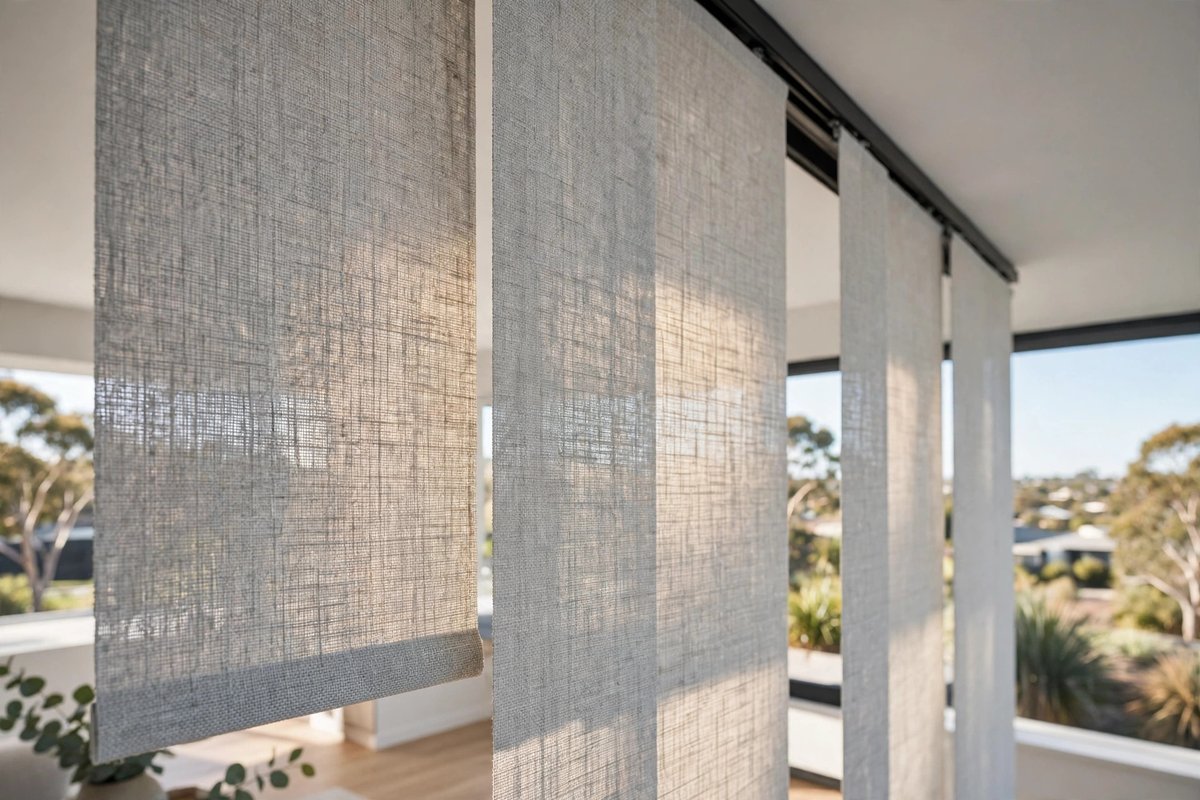
Vertical blinds are the product panel glides are most often compared with, and the difference is in the look and the feel. Vertical blinds use narrow slats that twist open and closed, but the slats can swing in a breeze and look dated in a renovated home. Panel glides use wide flat panels that stay still in the breeze, stack in a tidy block, and read as a deliberate design feature rather than a budget fix. If your home still has old verticals on the sliding doors, a panel glide is usually the upgrade that changes the whole room.
Sheer curtains are the softer alternative, and they suit a different mood. A full width sheer drifts beautifully when the sea breeze comes through, and it gives a room a relaxed, layered feel that panels cannot match. The trade off is that sheers do not block heat as well as a blockout panel, and they need more room to stack when open. Some homeowners layer a sheer in front of a panel glide for softness, but for most living rooms the panel glide alone is the cleaner choice. Roller blinds still win on a standard sized window, and plantation shutters win on a feature window where the look matters most, but neither handles a four metre sliding door as gracefully as a panel glide.
- Vertical blinds twist and swing in a breeze; panel glides hang flat and still.
- Sheer curtains give softness and movement; panel glides give stronger heat and privacy control.
- Roller blinds suit standard windows; panel glides own the wide openings.
5. Measuring and Fitting: Tracks, Stacking and Clearance
The measuring details are what separate a good panel glide job from a frustrating one, and stacking space is the first thing to check. When the panels are open they need somewhere to sit, usually between 300mm and 600mm of wall beside the opening, depending on how many panels there are. If the opening runs wall to wall, the installer may suggest splitting the stack to both sides. This is the single most common surprise with panel glides, and a professional measure catches it before anything is ordered.
The track itself can be ceiling mounted or face fitted to the wall or architrave, and the choice depends on your ceiling and cornice. A ceiling mount gives the cleanest look and the tallest drop. A face fit works better where there is a pelmet, a bulkhead, or an air conditioner unit above the door. The installer will also check clearance for door handles, security screen doors and any furniture that sits close to the glass, because a panel that catches on a door handle every time it slides will annoy you within a week. For a measure that covers stacking, clearance and track choice properly, contact us for a free measure and quote.
- Check stacking space first: panels need spare wall beside the opening when open.
- Ceiling mounts suit square set ceilings; face fits suit pelmets and bulkheads.
- Clear door handles, security screens and nearby furniture before the track goes up.
6. Living With Them: Cleaning, Salt Air and Daily Use
Panel glides are among the easiest window treatments to live with in a dusty city. Perth dust settles on every flat surface, and a flat panel is far easier to clean than a slatted blind or a pleated curtain. A regular vacuum with a brush attachment takes care of most dust, and most fabrics can be spot cleaned with a damp cloth. A badly marked panel can usually be unhooked and replaced on its own.
Near the coast, from Cottesloe and Scarborough down to Fremantle and Rockingham, salt air is the slow enemy of every track system. A quick wipe of the track channels and a check that the panels still slide freely will keep the system smooth for years. In winter, a blockout panel glide also helps keep draughts down, because the overlapping panels form a more complete barrier than slatted blinds. Keep the track free of grit after a dusty summer day, and the glide will stay as smooth as the day it was fitted.
- Vacuum with a brush attachment for routine dust; spot clean marks with a damp cloth.
- Individual panels can usually be replaced without disturbing the rest of the blind.
- Wipe track channels regularly in coastal suburbs to stop salt and grit building up.
7. Cost, Lead Time and Getting a Quote
Panel glide blinds typically sit in the mid range of window treatments for a wide opening, because one track system replaces what would otherwise be two or three separate blinds. The final figure depends on the width of the opening, the number of panels, the fabric, and whether you add motorisation, so a quote based on your actual measurements is the only honest way to price the job. As a guide, a standard sized sliding door job is usually comparable in cost to a good quality set of vertical blinds, while delivering a far more modern result.
Lead time is usually a few weeks from measure to install, because panel glides are made to order for your opening. Motorised versions can take a little longer. If you are renovating, order the measure once the doors are in and the floors are down, so the drop is measured exactly. For other wide opening ideas, see our guide to blinds for sliding doors, and for a measure and an honest quote on your opening, contact us today. For shade on the alfresco itself rather than the glass, our outdoor blinds complete the picture.
- Made to order, so lead time is usually a few weeks from measure to install.
- Motorisation suits very wide openings and homes where easy operation matters most.
- Measure after doors and floors are in, so the drop is exact.
Frequently Asked Questions
Q. Do panel glide blinds work on sliding doors?
Yes, sliding doors are their best application. The panels slide sideways in the same direction as the door, so they never block the doorway, and they stack clear of the opening when you want full access. Just check that the stack has enough wall beside the door, or split the stack to both sides on a very wide opening.
Q. Can panel glide blinds be motorised?
Yes, motorised panel glides are available and they suit very wide openings well, because one motor moves the whole set of panels smoothly. A remote or wall switch replaces the wand, which is handy for high tracks and for anyone who finds a long pull awkward. Battery and mains options both exist, so ask which suits your room during the measure.
Q. Do panel glide blinds give privacy at night?
It depends on the fabric. Blockout panels give full night privacy, while light filtering and sunscreen fabrics give daytime privacy but will show silhouettes at night when the lights are on inside. If night privacy matters in the room, choose blockout, or pair a light filtering panel with a blockout layer.
Q. How do I clean panel glide blinds?
Vacuum the panels regularly with a brush attachment and spot clean marks with a damp cloth. Most fabrics do not need professional cleaning, and an individual panel can usually be removed and replaced if it is badly marked. Keep the track channels free of dust and grit so the panels keep sliding smoothly.
Q. How much wall space do the panels need when they are open?
Typically between 300mm and 600mm beside the opening, depending on how many panels the blind has and how wide each panel is. If there is no spare wall, the stack can be split to both sides, or the track can be fitted wider than the opening. Your installer should confirm the stacking plan at the measure, before anything is ordered.