If you live in Perth, you know the pattern. A hot dry summer afternoon turns the living room into a furnace, then a winter cold snap has you reaching for the heater before breakfast. Glass is the weak point in both seasons. It lets heat in when you want it out, and lets warmth out when you want it in. Honeycomb blinds Perth homeowners are choosing more and more often tackle that weak point head on, and they do it with nothing more than cleverly shaped fabric and still air.
This guide walks through how honeycomb blinds work, what they can and cannot do for your power bills, the difference between single cell and double cell fabrics, and the rooms where they earn their keep. No jargon, no inflated promises, just practical detail you can use when you are choosing window coverings for your home.
In This Guide
- How Honeycomb Blinds Actually Work
- What They Do to a Perth Summer
- What They Do in a Perth Winter
- Single Cell or Double Cell: Which One Should You Pick
- Light Filtering or Blockout: Picking the Right Fabric
- Top Down Bottom Up and Cordless Options Worth Knowing About
- Where Honeycomb Blinds Work Best in a Perth Home
- What to Ask Before You Order
- Frequently Asked Questions
1. How Honeycomb Blinds Actually Work
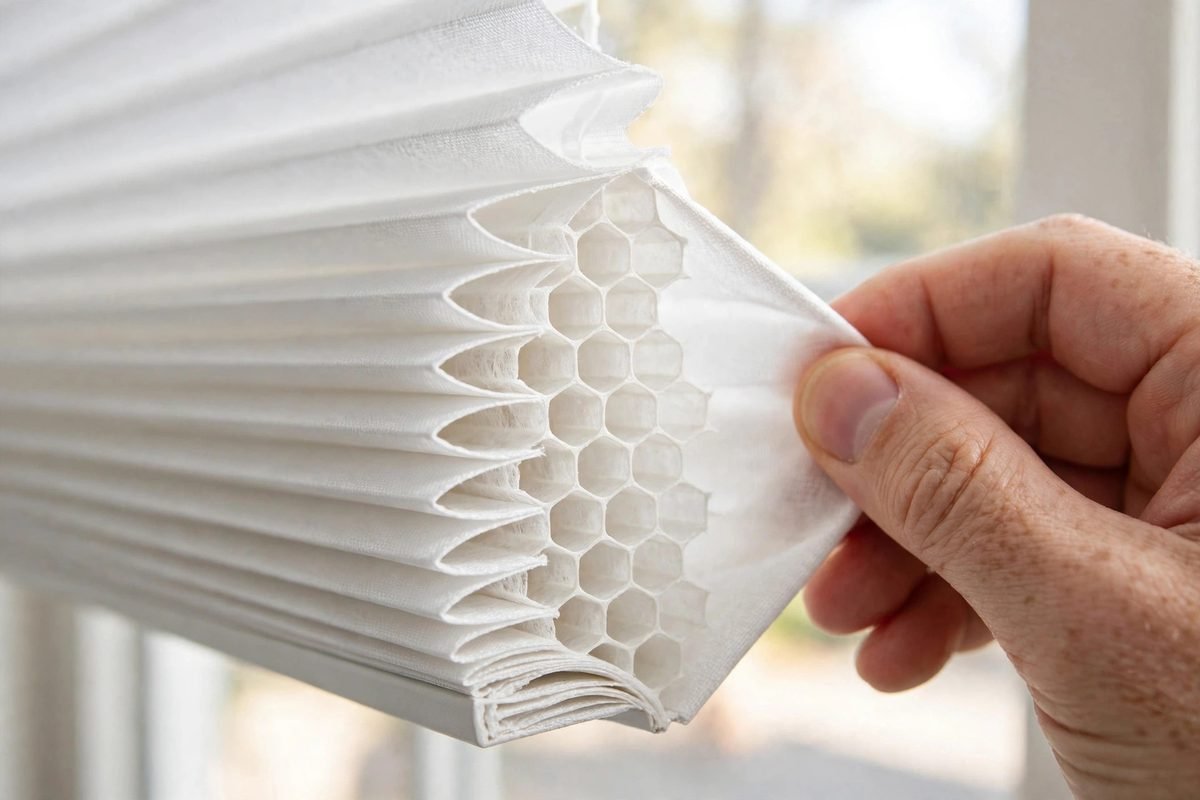
A honeycomb blind, also called a cellular blind, is made from fabric folded into a row of hexagonal tubes that look like a honeycomb when you see them from the side. Each tube holds a pocket of still air, and still air is a poor conductor of heat. That is the whole trick. Where a flat sheet of fabric lets heat pass straight through, the cells break the path and slow it down.
Think of it like the gap between the two panes of double glazed glass, except the gap is built into the blind itself. In summer the cells slow the heat coming in off hot glass. In winter they slow the warmth escaping from the room to the cold glass. The blind becomes a soft insulating layer that sits right where the heat transfer happens, at the window.
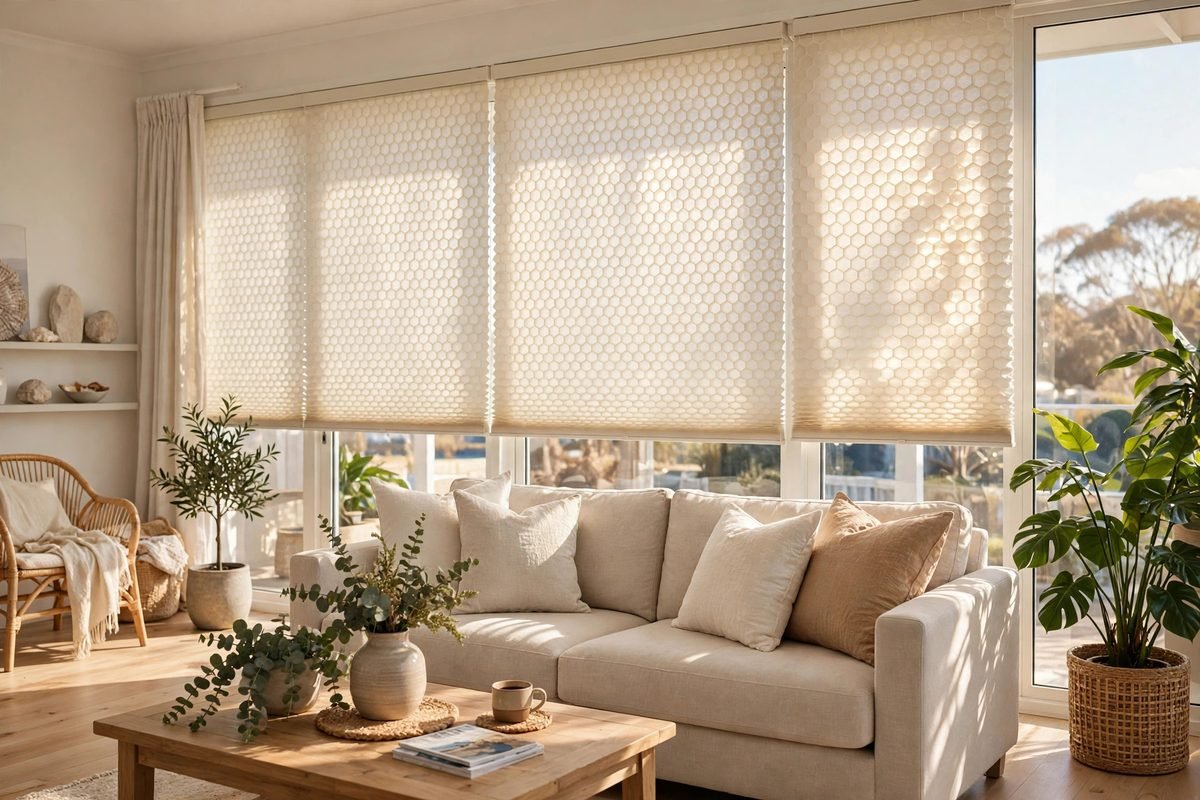
Honeycomb blinds still let you use the window normally. They raise and lower like a roller blind, stack up neatly at the top when you want the full view, and come in light filtering fabrics that glow softly in daylight. They are not heavy, they are not bulky, and from the street they look clean and simple.
- Single cell fabric has one row of air pockets and suits most rooms in a Perth home.
- Double cell fabric has two rows of pockets for extra insulation on large or west facing windows.
- Blockout lining can be added inside the cells for bedrooms where darkness matters.
2. What They Do to a Perth Summer
Perth summers are long, dry and fierce. The sun sits high, the afternoons push into the high thirties, and a west facing window can turn a room into an oven by three in the afternoon. Air conditioning copes, but it costs money every hour it runs, and a room with bare glass heats up again the moment the unit cycles off.
Honeycomb blinds change that cycle. Lowered over the glass before the sun hits, they put an insulating layer between the hot window and the room. The room heats up more slowly, stays cooler for longer, and the air conditioner does not have to work as hard to pull the temperature back down. You will still want the air conditioner on the hottest days, but it will run less, and the room will feel more even, without the hot spot right beside the window.
Timing matters. Lower the blinds on the sunny side in the late morning, before the heat builds, rather than waiting until the room is already hot. Then when the Fremantle Doctor rolls in, open the windows on the shaded side, raise the blinds, and let the sea breeze flush the warm air out.
3. What They Do in a Perth Winter
Winter in Perth is milder than the east coast, but the nights still bite, especially when a cold front sweeps in from the Southern Ocean. Glass loses heat fast on a clear winter night, and a room with big windows can feel chilly even with the heater running. That cold radiating off the glass is what makes you pull a blanket over your knees in the living room.
Honeycomb blinds help here too, in the same way they help in summer, just in reverse. Lowered in the evening, the cells trap a layer of air between the room and the cold glass, so the warmth from your heater stays in the room longer. Bedrooms feel noticeably warmer at night, and the heater cycles less often. It is a small change you feel every evening rather than a dramatic one you notice once.
One honest note: honeycomb blinds reduce condensation on windows because the glass stays closer to room temperature, but they will not fix a home with serious damp or poor ventilation. If your windows weep every winter morning, the blinds will help at the edges, and the bigger fix is airflow and heating habits.
4. Single Cell or Double Cell: Which One Should You Pick
Single cell honeycomb blinds are the standard choice, and for most Perth rooms they are all you need. The fabric is lighter, the stack is smaller when the blind is raised, and there is a wider range of colours and fabrics. In a living room or a study with average sized windows, single cell gives you a real insulation lift without any downside you would notice day to day.
Double cell blinds add a second row of air pockets, which lifts the insulation further. The trade off is a deeper stack when the blind is raised and a slightly heavier feel. They earn their place on the windows that take the worst of the climate: big west facing windows in suburbs like Joondalup and Rockingham, floor to ceiling glass in a modern home, or a bedroom where you want the room as warm as possible on a winter night.
If you are choosing for the whole house, a mix is often the smart move. Double cell on the worst windows, single cell everywhere else. You get the insulation where it counts and keep the lighter look and lower cost on the rest. Ask us to quote both on the same windows and you can see the difference plainly before you decide.
- Single cell: lighter, neater stack, wider fabric range, suits most rooms.
- Double cell: stronger insulation, best for west facing glass, large windows and bedrooms.
- A mix across the house usually gives the best balance of comfort and cost.
5. Light Filtering or Blockout: Picking the Right Fabric
Light filtering honeycomb fabric softens daylight and gives you privacy during the day while the room still feels bright. From outside, no one can see in clearly, and from inside you still get a gentle glow rather than a dark room. This is the right choice for living rooms, kitchens and home offices, where you spend the day and want the light without the glare and the heat.
Blockout honeycomb fabric has an opaque lining inside the cells, so almost no light gets through when the blind is down. Bedrooms are the obvious home for it, and it is a genuine help for shift workers, young kids and anyone who sleeps lightly. A dark room plus the insulation of the cells makes for better sleep on hot summer nights and cold winter mornings alike.
Be honest about which rooms need which fabric. Blockout in a living room can feel gloomy by day, and light filtering in a bedroom can leave you awake at first light in summer. Think room by room instead of picking one fabric for the whole house. If you love sheer fabric in the living room, pair honeycomb blinds with sheer curtains for the best of both.
6. Top Down Bottom Up and Cordless Options Worth Knowing About
Top down bottom up operation is one of the best features of a honeycomb blind, and it suits Perth homes beautifully. The blind can lower from the top while the bottom stays up, so you get daylight and a view of the sky while the lower half of the window stays covered for privacy. It is ideal for street facing windows in suburbs like Mount Lawley and Victoria Park, where the footpath is close and the neighbours are nearer than you would like.
Cordless operation is worth considering in any home with young kids or pets. There is no looped cord hanging beside the window, so there is nothing for a curious toddler to reach, and the blind raises and lowers with a gentle push or pull on the bottom rail. Motorised honeycomb blinds go a step further and suit hard to reach windows over stairwells or above kitchen benches, where a cord would be awkward or out of reach.
These options cost more than a standard corded blind, so think about where they add real value. Cordless in the kids rooms and the playroom, top down bottom up on the street facing windows, and standard operation everywhere else is a sensible split that keeps the budget under control.
7. Where Honeycomb Blinds Work Best in a Perth Home
Bedrooms are the strongest case for honeycomb blinds. You get darkness with blockout fabric, warmth on winter nights, and a cooler room in summer, which all add up to better sleep. In a coastal suburb like Fremantle or Cottesloe, the fabric also handles salt air well with a simple wipe down, and there is no timber to swell or metal to mark.
Living rooms with large windows are the second best spot, especially in newer homes around Baldivis and Ellenbrook where the glass area is generous and the afternoon sun is direct. Honeycomb blinds soften the glare on the television, cut the hot spot beside the glass, and still stack away neatly when you want the full view of the garden.
Very wide openings and sliding doors need a bit of thought. Honeycomb blinds work well on a sliding door if the span is moderate, but for very wide openings a panel glide blind or a plantation shutter can be the more practical choice, because the blind stays stable and easy to operate across the full width. Ask us for a free measure and quote so we can check the span properly.
8. What to Ask Before You Order
Honeycomb blinds are made to measure, so the measure is where a good result starts. Windows in Perth homes vary more than people expect, especially in older homes in suburbs like Subiaco and Maylands where frames can be out of square. A careful measure, or a free professional measure from our team, avoids gaps at the edges where light and heat sneak through.
Ask whether the blind will sit inside the window recess or on the face of the architrave, and how deep the stack will be when the blind is raised. An inside mount looks tidy and shows off the frame, but a shallow recess can leave the blind sitting proud. A face mount covers the whole opening and blocks more light at the edges, which suits bedrooms. There is no single right answer, it depends on the window and the room.
Finally, ask about cleaning and care. Honeycomb fabric is easy to look after with a regular vacuum using a brush head, and marks can be spot cleaned with a damp cloth. The fabric should never be soaked or machine washed. If you want advice before you order, contact us and we will talk through your windows.
- Get a professional measure, or measure carefully yourself, so the blind fits the opening without gaps.
- Choose inside mount for a tidy look, or face mount for better light block in bedrooms.
- Ask for both single cell and double cell pricing on your worst windows before deciding.
Frequently Asked Questions
Q. Do honeycomb blinds really cut energy bills?
They reduce heat transfer through your windows, which is where a lot of heating and cooling energy is lost in a Perth home. That usually means your air conditioner and heater run less, but the size of the saving depends on your glazing, how many windows you cover, and how you use the blinds day to day. Treat them as a solid insulation upgrade, not a magic fix, and lower them before the sun hits and open up for the afternoon breeze.
Q. Are honeycomb blinds good for Perth summers?
Yes, they are one of the better choices for Perth summers. The air pockets in the fabric slow the heat coming through hot glass, so rooms stay cooler for longer and the air conditioner works less hard. They work best when lowered on the sunny side of the house before the heat builds in the late morning, then raised in the afternoon to let the Fremantle Doctor breeze through.
Q. Can honeycomb blinds block out light completely?
Blockout honeycomb fabric blocks almost all light, but a small amount can still slip in at the edges and around the cords, because the blind sits inside a frame rather than sealing to it. For most sleepers that is fine, and a face mount fitting reduces the edge gaps further. If you need total darkness, pair the blind with a curtain over the top.
Q. How do you clean honeycomb blinds?
Vacuum them regularly with a brush head on low suction, working from top to bottom, and spot clean marks with a lightly damp cloth and mild soap. Never soak the fabric or put it in a washing machine, and avoid harsh cleaners. In coastal homes, a quick wipe down every few weeks keeps salt residue from building up on the fabric.
Q. Do honeycomb blinds work on sliding doors and large windows?
They work well on moderate spans, including sliding doors, but very wide openings can be a stretch for a single honeycomb blind. For wide openings, panel glides or plantation shutters are often more practical and easier to operate. A free measure and quote will confirm the best option for your exact opening.